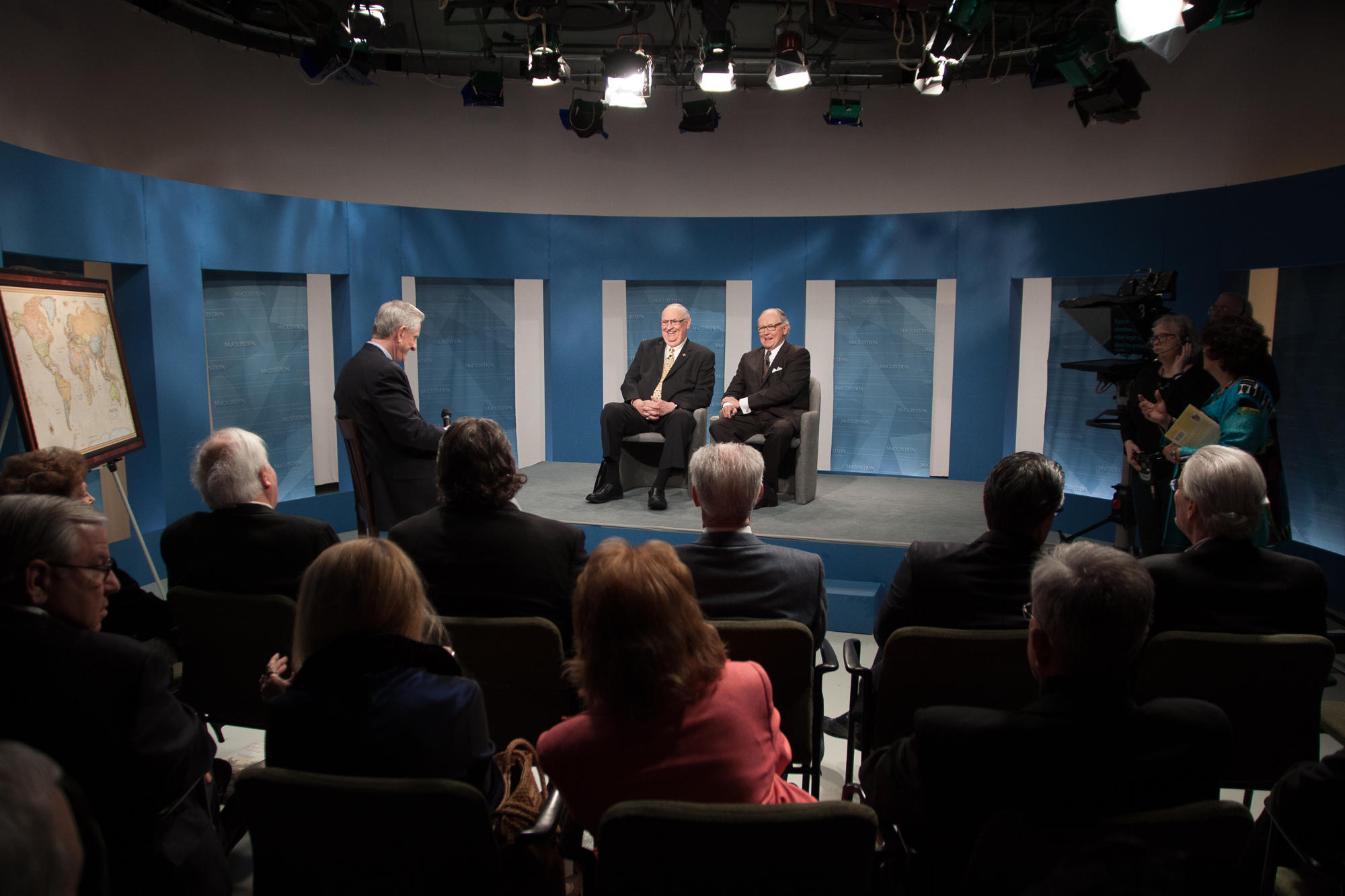
Revolutionary change is sweeping the Middle East and North Africa; in some countries triggering massive outbreaks of violence; in others a more peaceful transition.
Can the fairly peaceful changes achieved in Egypt and Tunisia be achieved across the region or will Libya and Bahrain be the model? And why are there such decided differences in how leadership reacted to their peoples’ protests?
Panelists Include:
- Jim Falk: President/CEO of the World Affairs Council-Dallas Ft. Worth,
- Radwan Masmoudi, PhD: President of The Center for the Study of Islam and Democracy and
- Tod Robberson: Pulitzer Prize Winner, Dallas Morning News Editorial writer
Join us as panelists talk about what makes each country different; the possibility of real democracies emerging and what led to the continuing wave of uprisings.
Tod Robberson and Jim Falk, remind us that the various countries in the Middle East and North Africa are not monolithic. Each has their own distinct cultural differences , languages and society. Egypt and Tunisia, largely homogenous countries, with clear national identities and substantially well developed civil societies, would of course react differently than the more heterogenous societies found in Yemen, Libya, Sudan , Iraq, where the varied social, cultural, tribal ethnic and religious structures of each country, their degree of economic, development, leadership and other factors greatly influence how changes of this magnitude are viewed and acted upon. Tod says, “leaders are two-faced and that is part of the problem.”
One of the questions asked is one that many Americans take issue with, Islam and democracy. The issue raised, “will present conflicts lead to more democratic societies?”
I first met Dr. Masmoudi three years ago, when I was working on a new documentary; Divergent Voices, Seeking Democracy in the Middle East. He hosted a conference on Islam and Democracy, and I had the opportunity to interview several of his speakers from, Egypt and the Muslim Brotherhood to American Muslims and invited him to take part. Dr. Masmoudi voices a very strong “yes”. In fact he challenges the myth that Islamic societies cannot be democracies and reminds us of Turkey, Senegal, Malaysia and Indonesia and others who in fact have made that transition.
Jim Falk reminds us that some of the conflicts have perhaps been “influenced ” by technology. In Tunisia, former US Ambassador to Tunisia, Robert Godek’s messages were “exposed” on Wiki Leaks. Al Arabiya and is showing the reality of the situation as never before. In Egypt- the Internet was actually shut down for 48 hours, causing numerous challenges to business and banking. He believes that technology, from satellite TV to Al Jazeera, is a pivotal driving force to change. The masses are seeing what actually happens in oppressive governments and reacting accordingly.
The outcome: people are excited about the possibilities they see. They are fed up with 30 some odd years of oppression and want a voice.
Stay tuned for Part Two- as we discuss that voice and its importance…
Written by Niki Nicastro McCuistion Executive Producer/ Producer
Libya has deteriorated into civil war; European and American forces have intervened and remarkable events are shaping the Middle East. And while many hoped that the situations in Tunisia and Egypt would be a model throughout the region, Bahrain, Yemen, Syria, Libya and others have a different foundation for the way events are taking shape.
Joining us for Part Two of Why Should We Care About the Middle East are our guests from Part One:
- Jim Falk: President/CEO of the World Affairs Council/ Dallas Ft Worth;
- Dr. Radwan Masmoudi: President/ CEO of The Center for the Study of Islam and Democracy and
- Tod Robberson: Editorial columnist and Pulitzer prize winning journalist with the Dallas Morning News.
Mr. Robberson, who has extensive background in the region, comments on the historical parallels to the Spanish Civil War; a dominant entity in power, ruthless forces, and opposition from many different groups trying to find a uniformity of command make it very difficult for a smooth transition to take place in Libya.
The situation is of course, chaotic, difficult and unpredictable as a result. Jim Falk, who has lived in Tunisia, comments on the homogeneous populations of countries like Tunisia and Egypt, which made the transition flow more effectively than Libya’s; that a very tribal society.
Dr. Masmoudi predicted the future when he stated that the International community has a moral obligation to interfere in Libya for many reasons. First that the country is run by a madman, intent on killing his people, that Gadhafi is a dictator who has built the government around him as the central figure so there is no real government, no real army, institutions are weak and “if the international community does not interfere we may have a humanitarian tragedy.”
As Jim Falk comments, in Tunisia and Egypt it was the army that told the leaders to step down, such is not a possibility in Libya and other countries in the region.Tod Robberson is also concerned regarding America, European and UN intervention, which could cheapen the effect of the citizen revolutions. He cautions that we proceed slowly and not dampen the euphoria of the people who have worked hard for democratic outcomes, “have sacrificed their lives and who are not going to trade one restrictive power for another.”
Jim Falk counsels: “We can’t engineer these elections. We’ve done that in the past and it never works.”
The concern throughout the world is the possibility of more violent extremism as a result of the abusive, oppressive regimes in question. Will the countries in the region be able to transition to democracy, which is wanted by so many of its citizens? Or will slogans and violence prevail?
Join us as we keep talking about things that matter with people who care…
Niki Nicastro McCuistion
Executive Producer/ Producer
The Roots of War… the Road to Peace, provides an intriguing look at the complexity of terrorism and the events that led to 9/11. The 90-minute documentary examines radical Islamist terrorism and its impact on the world stage. Shot on location from Baghdad to Saudi Arabia- through the eyes and voices of key experts, scholars and everyday people, Roots examines history, facts and analysis and gives perspective on the social and political reasons behind most acts of terrorism. It looks at the conflicts in the Middle East that have created a breeding ground for these acts of violence and the role the United States plays.
At a time in history when we are still fighting the “war against terror” the McCuistion team (Niki and Dennis, producers of the McCuistion Program, now in its 20th year with KERA, Channel 13), takes an in depth, non-partisan, balanced look at terrorism.
“Our purpose was to give historical context and as balanced a perspective as possible on the social, human, geo-political and economic costs of terrorism, whose seeds were sown throughout history in the varied conflicts between the great civilizations and religions of the world,” says Niki McCuistion, Executive Producer -Director of the documentary. “We believe we succeeded in presenting an objective look at a complex issue that continues to dramatically impact our everyday lives.”
Click here to view The Roots of War trailer.
For more information contact:
www.therootsofwar.com
nikin@nikimccuistion.com
214-750-5157