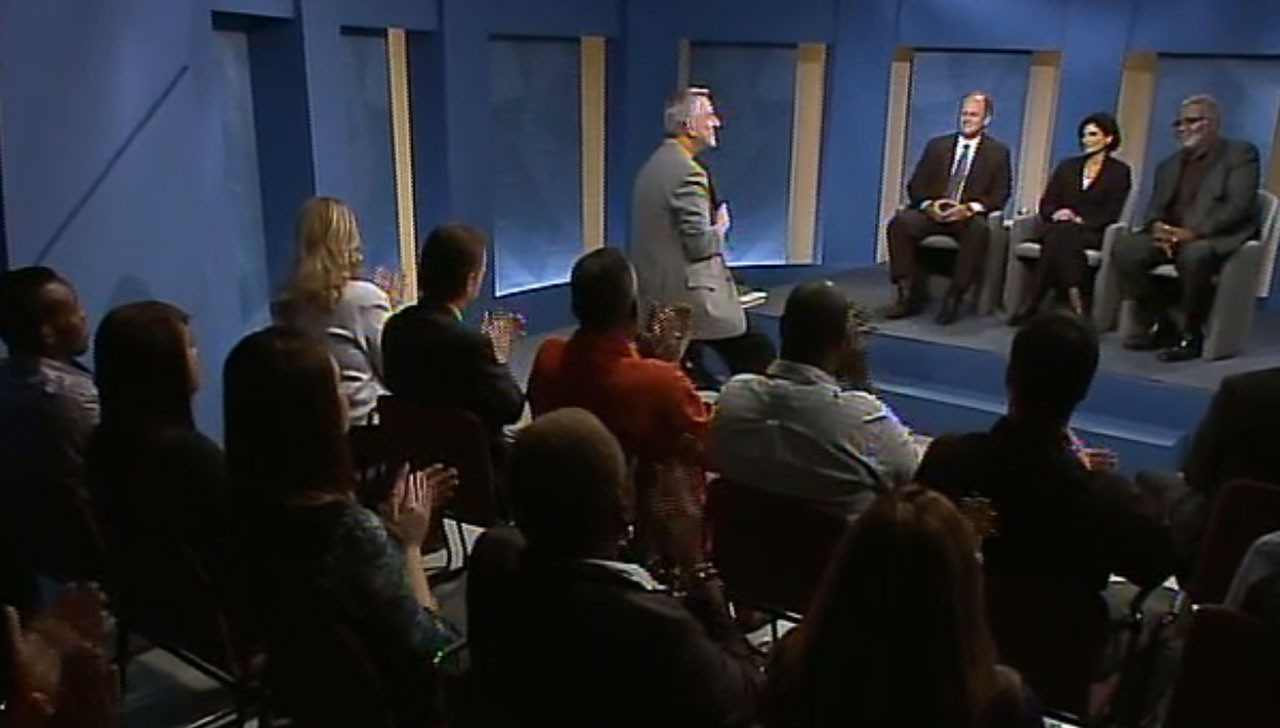
This entry is part 1 of 6 in the series 20 Years of McCuistion.  

17% of our GDP is spent on health care, thus health care has gone from being a personal issue to a public policy debate. In this 20 year retrospective on this issue we feature various perspectives: liberal, conservative and libertarian.

Dr. Ed Annis on the Health Care Debate

In 1994 Dr. Ed Annis the author of Code Blue joined us with his views. Dr. Ed Annis had rebutted President John Kennedy on his platform on health care.

We asked him, “How did the national health care debate come about?”

Dr. Ed Annis responded, “Well there were philosophical flaws, politicians were biased and the media was belligerent… The problem is government not health care.” He addressed Medicare by saying, “People should be allowed to provide for themselves if they can.” Dr. Ed Annis stated that just because one has a birthday of 65 does not mean one is entitled. He then addressed permeation and gradualism.

Max Sawicky on Health Care as a National System

Dennis quoted Arthur Schlesinger, from The Partisan Review of 1947, on the transition to socialism. And we made the transition to Max Sawicky of the Economic Policy Institute who joined us in 1999. Max said, “I would move health care into a national system.” Max believes we can’t afford anything else. “If health care is made on the basis of profit- everyone is priced according to their worth.”

Dr. John Goodman on the “Bureaucratic Health Care System”

Dr. John Goodman, the father of medical savings accounts, joins us in 2010, and has this to say:

“We have a bureaucratic, dysfunctional health care system with perverse incentives… In 1993 Hilary Clinton, wanted to nationalize health care. She failed. Look at the “S Chip” program for children that ration health care, and the difficulty seeing doctors. Expenditures for health care have gone up from $500 billion in 1990 to $2 trillion today.”

Impact of Drugs on Society

From health care we go to drugs and their impact on society and our system overall.  Jacob Sullum, Senior Editor of Reason Magazine, joins us in 2007 and comments on the direct correlation between prohibition and drugs. We hear from several voices on various sides of this issue.  Philip Jordan, former director of the El Paso International Center, seemed to find a similarity between prohibition and drugs, even though the drug enforcement code Dennis reads says differently.  Rusty White, a former prison guard says, “In a controlled environment like a prison, drugs still get in.”

From drug use to new cures and behaviors we visit with Dr. Kevin Gilliland, CEO of Innovations 360. “Drugs,” he says, “wreck a person’s self image. They rob you of your sense of self. Addiction is not a moral failing.”

On that same program in 2009, Christopher Kennedy Lawford joins us with his story of the genetic disease within his family, how as an adolescent he lived through the assassinations of two uncles, and he comments on the conditions within his family and how this led to a very troubled youth. He comments, “traumatized and troubled youth, sometimes turn to drugs or alcohol”. He says, “Drugs and alcohol gave me a way out. They saved my life.”  Christopher Lawford Kennedy is now an activist, educating  others on alcohol and drug abuse.

Health and Wellness

From drugs and dependence we go to health and wellness, with a look at a revolutionary new care, Hyperbaric Oxygen Treatment.  Alene Creacy and her husband Bill join us with their story and the importance of this treatment. Claudine, a Canadian  mother, talks about the process and how it has helped her sons, born with cerebral palsy. Claudine actually demonstrates the chamber and how the oxygen helps.

In terms of wellness, Dr. T. Colin Campbell joins us in 2009 to talk about good eating habits. Dr. T. Colin Campbell, author of The China Study, the most comprehensive nutritional study ever conducted, became a vegetarian as a result of his research. He  shakes his head at the hosts’ eating habits and says, “no to sugar, no to burritos, but salsa isn’t bad. And chocolate, well, that’s a plant based food!”

***

#1819 – 04.08.10

The McCuistion Program premieres in Las Vegas starting February 7th, with the series Twenty Years of McCuistion – Part One: Education and Our Children.

Time and Channel: 4:00 PM PST – Vegas PBS Rewind, Cox Cable, Channel 110

If you’re in Vegas, tune in and let your Vegas friends and colleagues know.  This is one time that “what happens in Vegas  should not stay in Vegas”.

For the last several years we’ve attended Freedom Fest- Las Vegas and interviewed key thought leaders at the PBS studio including: Steve Forbes, Steve Moore, Daniel Mitchell, David Boaz and Richard Rahn, Charles Murray (author of The Bell Curve), Michelle  Muccio (Acton Institute), Mark Skousen, and numerous others.  So, it is with great pride and pleasure that we are now available on the Las Vegas PBS station.

Vegas PBS is southern Nevada’s local PBS affiliate.  The company also programs 13 additional television and cable public service media channels and produces over 700 hours a year of local programming. The mission of Vegas PBS is to use telecommunications technology and local outreach activities to support the educational, cultural, health, safety and civic needs of Southern Nevada by creating and acquiring content that informs, entertains, and improves people’s lives.

Vegas PBS also offers multimedia products and educational services directly to classrooms, homes and businesses, along with extensive local outreach efforts targeted at literacy and health.  The company serves 1 million a month with its TV and cable channels, records over 12 million classroom student viewings of downloaded digital media every year, enrolls over 7,000 people a year in “for-credit” classes, and receives over 6 million web page visits a year.

In 2010, Vegas PBS will dedicate a new 108,000 square foot Educational Technology Campus which will allow low cost production and storage of digital media on multiple distribution platforms.  The goal is to meet the public safety, public education, public health, workforce development and cultural access needs and aspirations of southern Nevada. The facility has been designed to incorporate a large number of sustainable building features, furnishings and equipment standards as established by national certification organizations making it the “greenest” television station in North America.

We welcome your questions and comments. I can be reached at (214) 750-5157.

As always thanks for watching as we talk about things that matter… with people who care.

***

Niki Nicastro McCuistion
Executive Producer/Producer

This entry is part 4 of 8 in the series TEDx SMU, Dallas.  

Tedx SMU Backstage Interview - AfricaAt TEDxSMU last month we had a brief visit with William Kamkwamba, the Don Quixote of Africa, and Bryan Mealer, journalist.  William Kamkwamba and Bryan Mealer are co-authors of The Boy Who Harnessed the Wind, one of Amazon’s Top 10 books of the year.

A truly remarkable story, The Boy Who Harnessed the Wind is the story of William Kamkwamba, a young man from Malawi, who, in 2002, at fourteen years of age endured one of the worst famines in Malawi’s history. The famine killed thousands of people and forced the Kamkwamba family of 20 to the brink of starvation. William had to drop out of school since his father, a corn and tobacco farmer, could not afford the $80 a year school fees.

But William was just as hungry for education as he was food. William tells us,

“I looked at my father in those dry fields and knew it was a future I could not accept.”  Becoming a farmer “who farmed to live rather than for profit was unacceptable.”

So he continued studying on his own at a local library which had just opened in his old school. The library was funded by the U.S. Agency for International Development. Even though his English was very rudimentary he taught himself basic physics, primarily through studying the diagrams and photos in the bedraggled fifth grade science book, Using Energy. In his autobiography, he says, “The book has since changed my life.”

While his villagers poked fun and thought him crazy, William rummaged through junk at scrap yards and used garbage- discarded tractor fans, shock absorbers, plastic pipes, and bicycle parts and built a windmill that generated enough electricity to produce twelve volts that powered four lights. A second windmill was able to irrigate the family garden. Since electricity is a luxury that fewer than 2 percent of Malawians enjoy, news spread. In his book he says, “A windmill meant more than just power. It was freedom.” He tells us, “My family would never go hungry again.”

Bryan Mealer, whose work has appeared in Esquire and Harper’s, among other publications, is the author of All Things Must Fight to Live: Stories of War and Deliverance in Congo and a former Associated Press staff writer, had been based in Kinshasa, Congo for four years. He was despondent and burned out, constantly reporting on the bad news that comes out of Africa. He happened to read a Wall Street Journal story about William, after William had gone to a TED conference, and said to himself, “This is the story I’ve always wanted to write.”  He believes a reporter has a responsibility to tell the news, good or bad, but “to find good stories you have to look for them.” The two teamed up to write an inspiring work.

Join us in this short clip as we talk about things that matter with people who care…

Niki Nicastro McCuistion
Executive Producer/Producer The McCuistion Program