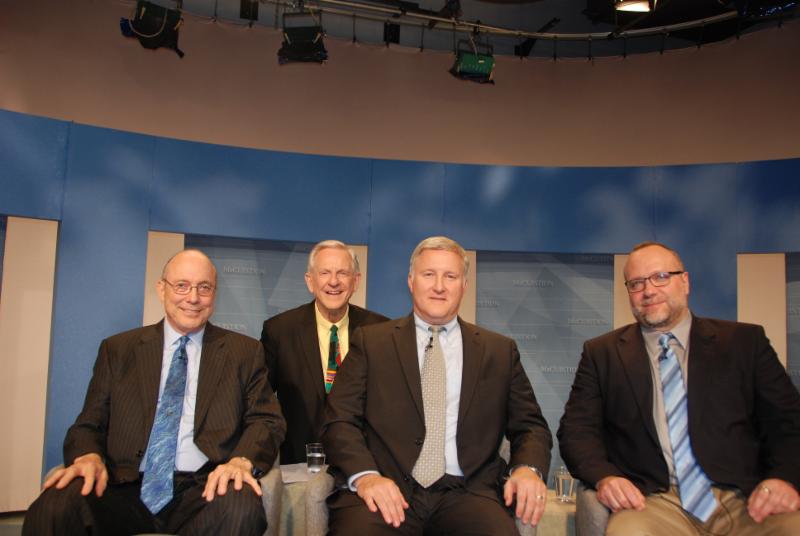
This entry is part 1 of 6 in the series 20 Years of McCuistion 

17% of our GDP is spent on health care, thus health care has gone from being a personal issue to a public policy debate. In this 20 year retrospective on this issue we feature various perspectives: liberal, conservative and libertarian.

Dr. Ed Annis on the Health Care Debate

In 1994 Dr. Ed Annis the author of Code Blue joined us with his views. Dr. Ed Annis had rebutted President John Kennedy on his platform on health care.

We asked him, “How did the national health care debate come about?”

Dr. Ed Annis responded, “Well there were philosophical flaws, politicians were biased and the media was belligerent… The problem is government not health care.” He addressed Medicare by saying, “People should be allowed to provide for themselves if they can.” Dr. Ed Annis stated that just because one has a birthday of 65 does not mean one is entitled. He then addressed permeation and gradualism.

Max Sawicky on Health Care as a National System

Dennis quoted Arthur Schlesinger, from The Partisan Review of 1947, on the transition to socialism. And we made the transition to Max Sawicky of the Economic Policy Institute who joined us in 1999. Max said, “I would move health care into a national system.” Max believes we can’t afford anything else. “If health care is made on the basis of profit- everyone is priced according to their worth.”

Dr. John Goodman on the “Bureaucratic Health Care System”

Dr. John Goodman, the father of medical savings accounts, joins us in 2010, and has this to say:

“We have a bureaucratic, dysfunctional health care system with perverse incentives… In 1993 Hilary Clinton, wanted to nationalize health care. She failed. Look at the “S Chip” program for children that ration health care, and the difficulty seeing doctors. Expenditures for health care have gone up from $500 billion in 1990 to $2 trillion today.”

Impact of Drugs on Society

From health care we go to drugs and their impact on society and our system overall.  Jacob Sullum, Senior Editor of Reason Magazine, joins us in 2007 and comments on the direct correlation between prohibition and drugs. We hear from several voices on various sides of this issue.  Philip Jordan, former director of the El Paso International Center, seemed to find a similarity between prohibition and drugs, even though the drug enforcement code Dennis reads says differently.  Rusty White, a former prison guard says, “In a controlled environment like a prison, drugs still get in.”

From drug use to new cures and behaviors we visit with Dr. Kevin Gilliland, CEO of Innovations 360. “Drugs,” he says, “wreck a person’s self image. They rob you of your sense of self. Addiction is not a moral failing.”

On that same program in 2009, Christopher Kennedy Lawford joins us with his story of the genetic disease within his family, how as an adolescent he lived through the assassinations of two uncles, and he comments on the conditions within his family and how this led to a very troubled youth. He comments, “traumatized and troubled youth, sometimes turn to drugs or alcohol”. He says, “Drugs and alcohol gave me a way out. They saved my life.”  Christopher Lawford Kennedy is now an activist, educating  others on alcohol and drug abuse.

Health and Wellness

From drugs and dependence we go to health and wellness, with a look at a revolutionary new care, Hyperbaric Oxygen Treatment.  Alene Creacy and her husband Bill join us with their story and the importance of this treatment. Claudine, a Canadian  mother, talks about the process and how it has helped her sons, born with cerebral palsy. Claudine actually demonstrates the chamber and how the oxygen helps.

In terms of wellness, Dr. T. Colin Campbell joins us in 2009 to talk about good eating habits. Dr. T. Colin Campbell, author of The China Study, the most comprehensive nutritional study ever conducted, became a vegetarian as a result of his research. He  shakes his head at the hosts’ eating habits and says, “no to sugar, no to burritos, but salsa isn’t bad. And chocolate, well, that’s a plant based food!”

***

#1819 – 04.08.10

This entry is part 2 of 2 in the series Prescription Drugs 

This is part two of a two part series on pharmaceutical companies and their relationships with the Food and Drug Administration (FDA). Our focus is on the efficacy of prescription drugs as well as the cost for the consumer.

Jonathan Emord, attorney & author of The Rise of Tyranny and Dr. Charles B. Simone speak on the truth about the FDA.  An enormous amount of marketing dollars are spent by pharmaceutical companies to market their drugs. Thus,  patients learn to demand certain drugs from their doctors.  The problem with this is that often times over-the-counter drugs (i.e. Aspirin) or nutrients (i.e. fish oil) will have the same effect on one’s lifespan as a prescription drug.

Jonathan Emord has defeated the FDA six times and is well-versed in the issues surrounding the corruption of the United States health care system. At the center of the FDA issue is that of accountability. The checks and balances that are in place for government are non-existent for the FDA.  The FDA Commissioner has the authority to create law (regulations), enforce violations, and judge the violation.  The Commissioner of any independent regulatory committee is virtually all-powerful. This means that 3/4 of the laws that are made are not made by representatives in Congress, but they are in fact made by unelected officials.  And because of the controversial nature of the committee issues and the fragile nature of congressional elections, congressmen will avoid making the tough decisions and instead diplomatically mail a letter to the regulatory committee.

Another key component to concerns about the FDA is the way that economics play a role in FDA approvals and rejections. Simply put, the government has censored information for solely economic reasons.  They further discuss the specifics of how and why they do this and the resulting effect on health care.

To learn more about censorship, Dr. Simone’s website will provide more information. He will also provide you with the tools to show you what you can do as a consumer to make a difference in these issues.

***

04.05.09 – 1726

This entry is part 1 of 2 in the series Prescription Drugs 

Did you ever wonder whether the prescription drugs you pay so much for are really bargains and even more importantly, whether they’re safe? Many of us share this concern, especially since the Food and Drug Administration (FDA) is supposed to be the regulator which assures that drugs are both safe and effective.

Jonathan W. EmordDr. Charles Simone of the Simone Protected Cancer Center and author of Cancer and Nutrition is joined by , author of The Rise of Tyranny. In part one of a two part interview with Dennis C. McCuistion they discuss the effects of politics and bureaucracy on prescription drug costs and safety.

One would think that the FDA would be one of the least corrupt government agencies, as it’s dealing directly with the health and well-being of American citizens. Unfortunately, it has become increasingly well-known that what the FDA approves is often times based more on politics, bureaucracy and economics than health.  The concern during recent years is that bureaucrats have been having an enormous amount of influence in what the FDA approves. In fact, the commissioner of the FDA has knowingly allowed unsafe drugs to enter the marketplace, in order to protect the proponents of those drugs so that they don’t suffer economic hardship.

Of the 19 industrialized countries, the United States is #1 in the amount of money we spend on health care and #19 in how much bang we get for our buck. The argument for the increased cost of prescription drugs is that it’s due to the FDA’s strict requirements on research. However, if you look at history you’ll find that members of the FDA have knowingly allowed harmful drugs to hit the market. Simone and Emord expound by giving several examples of times where the Commissioner of the FDA intentionally passed drugs that were undeniably confirmed to be dangerous.  They went on to further site instances where the medical reviewers (with political managers above them) required well-respected scientists to rewrite their reports and threatened if they did not. Because of this type of treatment, scientists are required to spend more money to protect themselves, thus the cost of drugs increases.

***

03.29.09 – 1725