During this episode on government spending, touching on budget deficits, the United States debt and taxes, Dennis McCuistion is joined by:
- Daniel Mitchell, PhD, Senior Fellow of the Cato Institute and former Senior Fellow for the Heritage Foundation
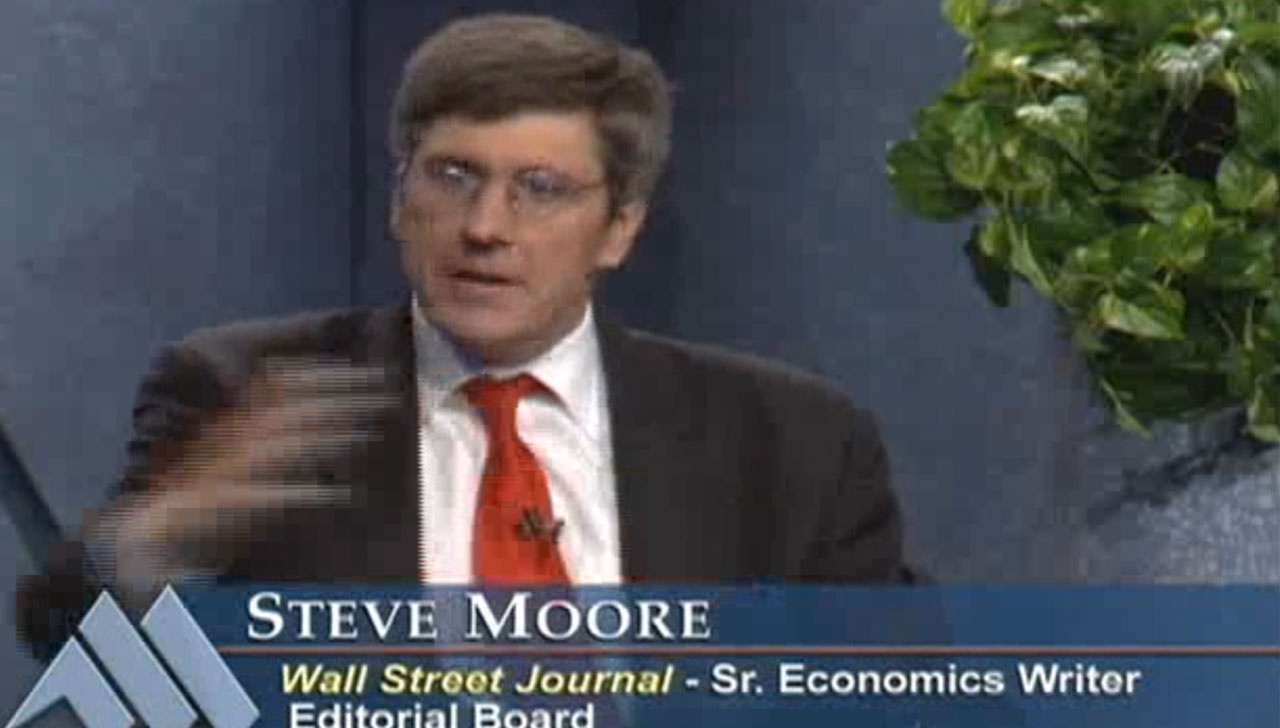
- Stephen Moore, member of the Editorial Board for the Wall Street Journal and senior economics writer
- Richard Rahn, PhD, Senior Fellow of the Cato Institute, Chairman of the Institute for Global Economic Growth. He is also a weekly economic columnist for The Washington Times.
During this engaging, high energy discussion on the role that government has played in the financial crisis of today, we are enlightened by the experts in causes, solutions, and cautions regarding budget deficits, United States debt and taxes.
Richard Rahn addresses supply side economics. Supply side economics is:
“a school of macroeconomic thought that argues that economic growth can be most effectively created using incentives for people to produce (supply) goods and services, such as adjusting income tax and capital gains tax rates, and by allowing greater flexibility by reducing regulation.”
Taxes
Addressing the flat tax, Richard Rahn says that it is presently used in 26-28 countries. However, Iceland is getting rid of their flat tax, which was too high at 37%. Flat tax is supposed to be a low rate system as it is in Central and Eastern Europe. He says flat tax is not a silver bullet. More growth and more entrepreneurship is still needed.
Stephen Moore and Daniel Mitchell also address the tax situation and address the fair tax. The fair tax is a national consumption tax that is essentially a sales tax. This would eliminate the need for corporate and personal income tax. They assert that this would be a dream come true and of great benefit, saying that the world is passing us by. They warn, the United States may have to raise taxes to pay for the new health care system.
Spending some time to discuss big government and 2010, they touch on tax cuts, government spending and predict that the death tax, capital gains and personal taxes will go up in 2010. The offer warnings on the vat tax as well.
Wrapping up the conversation, they discuss the Laffer Curve, tax rates, taxable income and tax revenue and how tax is collected. Citing history, they discuss the President Regan Administration and the current concern about a massive tax increase on the middle class.
This episode offers compelling inside into today’s economic times. We welcome your comments on the episode below.
–
1802 – 10.04.09
Podcast: Play in new window | Download
Why do countries around the world now seem to outstrip the United States in terms of free market philosophies as well as tax issues, from the flat tax to social security? Can the US catch up? During this installment of McCuistion Television, Dennis McCuistion is joined by three panelists on location at FreedomFest. Discussing the state of freedom in America, Dennis McCuistion is joined by:
- Daniel Mitchell – Senior Fellow at the CATO Institute
- Michelle Muccio – Washington D.C. Representative and Production Associate at The Acton Institute
- Larry Abraham – The late Larry Abraham was the co-founder of PanAmerica Capital Group, Inc. and long-time author and editor of the Insider Report, an international geopolitical investment newsletter with over 10,000 private subscribers, worldwide.
The last twenty-five years of United States history have been successful in leading America towards a smaller government. However, many economists and futurists look with question to the next twenty-five years to determine if, in fact, the trend will continue. There is a rising concern that socialist reforms will begin to take a hold on the free market system that has defined America for centuries.
Panelists discuss the free market system and how the opposing view of making the strong weaker by promoting economic equality is a dangerous approach. History and current affairs have produced clear evidence that the idea of “fair” doesn’t work. Larry Abraham, with his extensive international exposure, expounds on this viewpoint by explaining the international view of America right now.
Panelists also discuss the flat tax, social security reform and some of the empirical evidence that supports both. The panelists close the episode with FRTV’s Dennis McCuistion by offering suggestions for viewers to make a difference in these issues today.
***
1704
Podcast: Play in new window | Download
Economist and editorial writer for the Wall Street Journal, Stephen Moore, joins Dennis McCuistion to discuss a changing America in this edition of McCuistion Television. During the course of the dialogue, they discuss likely changes that will occur after the November 2008 elections, the uncertain economic environment, tax policies and the stock market.
In speaking of the 2008 economy, Stephen Moore admits that America has seen great prosperity in the past few years, but the economy of a changing America is slowing down. The reasons rest with the housing market and the weakening value of the American dollar. He addresses how the weakening dollar directly affects the price of food, oil, gas and inflation in general. He goes into deep detail about this, pulling in information regarding ethanol subsidiaries, the use of US farmland and cautions regarding overseas drilling versus taking advantage of the nation’s own natural resources.
Regarding the George W. Bush administration, McCuistion and Moore dialogue about the pros and cons, economically. He speaks on what the administration did right regarding tax cuts and what they did wrong in the way of overspending.
Exploring the subject of the fiscal debt and how taxes and tax revenues play into Government money, Moore offers his suggestions for remedying the tax situation and his support of a flat tax. Moore offers his warnings and advice regarding the rapidly dwindling social security, medicare and medicaid money storehouse.
Ending the conversation on the politics and economic policies of a changing America, Moore offers his suggestions for tax reforms so that the future generations will be okay as the economy changes and the fiscal debt remains enormous. Suggestions he offer viewers include:
- Don’t count on government benefits when you retire. Begin saving money at a young age.
- Rise up and take on politicians and tell them to stop spending enormously.
***
01.11.09 – 1711
Podcast: Play in new window | Download
Steve Forbes joins Dennis McCuistion to discuss his support of the flat tax, issues surrounding the global economy, his views on Washington policy and his perspective on where the government should be focusing. Steve Forbes is the Editor-in-Chief for Forbes Magazine and the author of Flat Tax Revolution.
As a forerunner in the proposal of the flat tax, Forbes is adamant that the flat tax issue should be on the forefront of the Presidential agenda. He states that it not only needs reformed, but health care and social security for young Americans must also be addressed. He goes on to discuss public opinion and his belief that although the flat tax will make the most sense long term, public opinion will be something that will need to be monitored and addressed as well and his suggestions on how to do that.
It’s the complexity of the current code that creates the problem. He sited a study where one average family’s tax information was given to 45 of the best preparers in the country and they came out with 45 different results on the amount of money the family owed.
Forbes continues the discussion by candidly addressing what he would have done differently if had been elected and the different place that would have put the country. He offered suggestions and support of off-shore drilling and nuclear power plants, saying it would offer 1 million new jobs, manufacturing and construction jobs, highly skilled and highly paid jobs, thus increasing jobs, energy and national security.
He finishes off the discussion by referencing some fundamental moral problems that have left America in the spot it is in today, demographics, social security, medicare and medicaid and his suggestions as how to fix the issues.
***
09.21.08 – 1718
Podcast: Play in new window | Download