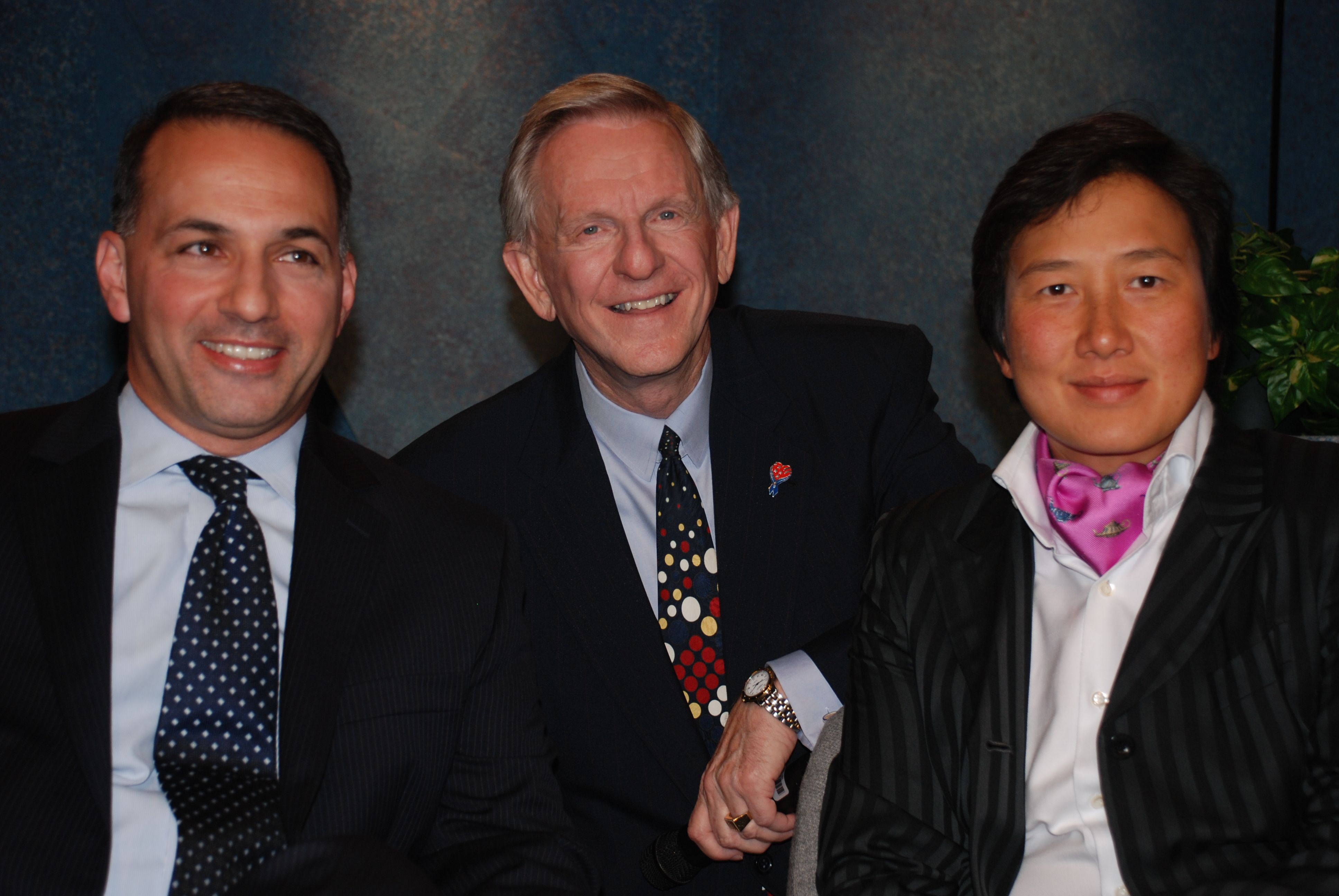
During McCuistion TV’s episode on Corporate Governance and its impact on China and the world, they address three questions related to the credit crisis and corporate governance:
- How do the Chinese see our economic situation?
- How has trade impacted what multinationals do?
- How has American economic and foreign policy impacted the rest of the world?
Guests include:
Angelina Kwan: Managing Director and COO, Asia Pacific, Cantor-Fitzgerald
The Hon. Mario Mancuso: Partner, Akin Gump Strauss Hauer & Feld, LLP, Former Under Secretary of Commerce
One of the points that host, Dennis McCuistion, addressed was that by-and-large we as a society do not often talk about China when discussing the American credit crisis and corporate governance, although it does impact them. He asked Angelina Kwan for her perspective.
Ms. Kwan believes that,
“The US is China’s best past and present trading partner. China wants a strong dollar. China really thinks that America has a great entrepreneurial spirit and it will get out of the current trade deficit.”
Ms. Kwan states that China will continue to work with the US and not in an adversarial role, but first and foremost as trading partners.
Dennis agrees, “We, the US and China, need each other. China is the largest creditor of the United States. We need to both figure out how they [China] will get paid.” Angelina Kwan tells us that the US needs to look at how it’s dealing with their dollars and its fiscal policy. China and the US are having serious discussions about China exporting less and the US having less dependency on exports and not relying so heavily on Asia and China.
The guests agree that trade is good for both partners. Mario Mancuso adds,
“A prosperous China is in the best interests of the United Sates and vice versa. Both being prosperous is in the global interest. These are the two largest economies in the world, and we agree on our ultimate objectives. We just can’t figure out how to implement those objectives- that’s the irony.”
He tells us, 95% of our customers are outside the US and if we build a wall, we close competitors out.
“A rules-based trading system is advantageous to competitive parties and the US is the most competitive in the world.”
US consumers benefit with better products at cheaper prices…
“An additional point, I take a backseat to no-one in terms of levying criticism, at the same time I don’t think the final chapter has been written on US economic leadership.”
And a special thank you to the Institute for Excellence in Corporate Governance,University of Texas at Dallas, School of Management, (http://som.utdallas.edu/iecg/) for providing the guests for this 4 part series on Corporate Governance.
Tune in for the rest of the story as continue to talk about things that matter with people who care…
Niki Nicastro McCuistion
Executive Producer/Producer
***
1809 – 11.22.09
Podcast: Play in new window | Download
During this weekend’s episode, Is “Corporate Ethics” an Oxymoron?, panelists discussed everything that surrounds corporate business ethics and the breakdown of ethics in portions of corporate America in the past years. During the program, panelists discuss how the ethics of corporations will only be as strong as the ethics of the individuals that make up the organization. This is a fascinating point as it leads to questions regarding hiring, promoting and the overall leadership training of organizations. Tagging onto the question of corporate business ethics, the overarching question of ethics in general beg question.
In 2003, reporter Jayson Blair made national headlines for his lack of ethical reporting. He had covered stories for the New York Times, ranging from the D.C. sniper case to the rescue of Jessica Lynch. Unfortunately, he had both plagiarized and fabricated details of many of the stories he had written.
In instances like these we see how a young man rose to the top very quickly and was perhaps given more opportunity than he had earned. This begs one to question the speed of promotion in organizations. John Maxwell, leadership guru, often says, “Talent may take you to the top, but character will keep you there.” In instances like this and in circumstances such as the fall of Enron, we’ll find that statement to be true.
We’d love your feedback on this issue of corporate business ethics.
- What are the benefits of requiring character training and mentoring for new employees?
- Should there be checks and balances in place for promotion to ensure that character is being assessed as well as talent?
- If talent can take you to the top but then cause the downfall of your company once you are there, how does one safeguard from that?
We’d love your feedback as we discuss things that matter with people who care.
***
Photo Credit: Applied Corporate Governance