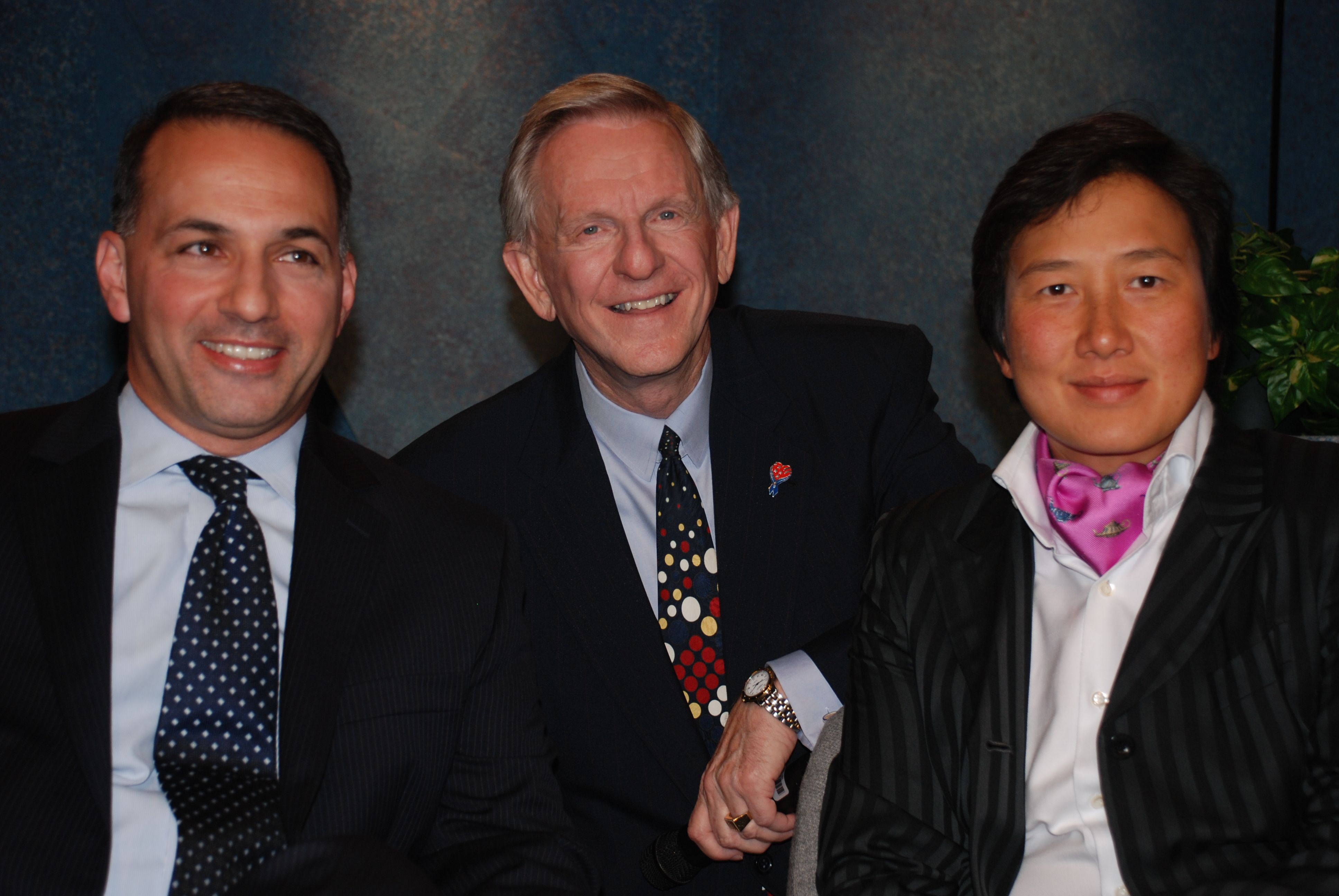
This entry is part 4 of 3 in the series 20 Years of McCuistion 

Join Dennis McCuistion in the fourth of a six-part retrospective series – 20 Years of McCuistion: Media and the Internet.

When we joined the ranks of the media in 1990, the worldwide web had just been invented. In fact, very few people even had access to email. Today? Blackberries and iPhones, Facebook, Twitter, and Google are all household names and media itself has changed as a result.

Now, many of us are getting our news online and foregoing paper copies altogether. Former news people are blogging and while many of us question the new style, we read the blogs and blog ourselves. This program explores how the Internet has changed our way of getting news, what news and the press really mean and its impact on democracy and public opinion.

In the last 20 years we have interviewed some of the most prestigious names in journalism including: Bill Moyers, Sam Donaldson, Bob Schieffer, Jim Lehrer, John Solomon, and joining in from a recent program, which featured Manny Mendoza and he and Mark Birnbaum’s doc-film, Stop the Presses, are Ben Bradlee, Anders Gylenhall, and Charles Ealey.

From the business world we’ve interviewed: the Father of the Internet, Dr. Vinton Cerf, and Tim Berners-Lee, creator of the World Wide Web. We’ve gotten a perspective on news today from Steve Forbes and Mary Mapes, author of Truth and Duty, a book about President George W.  Bush’ military incident that led to CBS’s firing her and eventually Dan Rather. Jeff Crilley, an award winning Fox News reporter, ends the media segment, commenting on its changing landscape and the dangers and opportunities this presents.

This retrospective episode entertains and informs as it gives us a very interesting snapshot of the new world of media and communication, a world that through its ever changing evolution leaves many of us struggling to keep up.

Niki Nicastro McCuistion
Executive Producer/Producer

***
1818 – 02.28.10

This entry is part 3 of 3 in the series 20 Years of McCuistion 

Motivation is often defined as that which gives purpose; action toward a desired goal. Sharing their stories on motivation on this 20th anniversary segment are several of the leading motivational speakers in the country.

We hear from motivational speakers:

  • The late, Rosita Perez, CPAE
  • Ed Foreman, CPAE, Founder of the Successful Life Program
  • Vinnie Roazzi, successful businessman and the author of The Spirituality of Success
  • Margo Chisholm, mountaineer and author of To The Summit

We also hear from corporate governance and leadership experts:

  • Sharon Allen, Chairman of Deloitte and Touche, LLP
  • Bill George, professor of management practice at Harvard Business School and former Medtronic CEO
  • Todd Bluedorn, CEO of Lennox International

… and many, many more.

Motivation

The late, Rosita Perez has the audience chuckling in the segment on The Healing Power of Humor as she describes her cold remedies when she is under the weather.

Ed Foremen joined us in 1994 and again in the studio the evening of the program’s taping. He talks about a motorcycle trip- and driving back to Texas from Louisiana. To test the bike he pushed the speed and flew down the road. All was well until he saw the flashing lights behind him. He had one thought (only briefly) of gunning the motor and crossing the Texas border. Of course he didn’t and when he stopped, the State Trooper asked for his license and said he had been clocked at 113 mph. Looking the license the trooper did a double take- “You’re 75 years old? Maybe you should act your age and you’d be a lot safer driving your age!”

Vinnie Roazzi and Margo Chisholm joined us in 1999, along with the late Art Berg, CPAE. The each spoke about their separate life challenges.  Art Berg shared his story of the car accident that left him a quadriplegic and how life still goes on after the worst happens.

The notables are joined by Bob Buford, author of Halftime and Jim Sirbasku, of Profiles International, who assesses Dennis McCuistion’s  leadership style- on camera, much to Dennis’s and the audience’s amusement. The motivation segment concludes with the late Ray Pellitier, CPAE, talking about coaching champions, as well as this author, Niki McCuistion, a coach and consultant, on the critical role coaching plays in helping individuals reach their goals.

Leadership and Governance

From motivation the program goes on to discuss leadership and governance. Dennis McCuistion talks about Jeff Skilling of Enron and how values and ethics are critical to successful leadership. Sharon Allen, Chairman of Deloitte and Touche, LLP and Todd Bluedorn, CEO of Lennox International, Inc. both comment on governance and ethics in corporate America, and how critical a role values play in the success of a company.

And to end the retrospective on motivation and leadership, Bill George, former Chairman and CEO of Medtronics and  a Professor of Management Practice at Harvard,  joins us from another segment to emphasize values in leadership and their critical role.

This program is one you won’t want to miss as it goes from humor, to inspiration and on to practical “how to’s”.

***

1817 – 02.21.10

This entry is part 2 of 3 in the series 20 Years of McCuistion 

In part two of the 6-part series, Twenty Years of McCuistion focuses on three key issues critical to our future: energy, the environment and immigration. Several notable guests join us in this retrospective look at the past as they add new information. We promise you a heated program as the participants express their views with passion, conviction and their perspectives.

ENERGY

Discussing global warming and climate change are:

Dr. William Kellogg with the National Center for Atmospheric Research, who joined us in 1992. Commenting on global warming as it was then titled, he said,

“The fact is that the global average temperature has been going up in this century. I think scientists have a great responsibility to define or to express whether they’re talking about science, which they have a right to talk about with some authority, or whether they’re talking about social /socio-economic problems, which they are probably not necessarily qualified to talk about anymore than the so-called ‘man in the street.’”

Some heated remarks are made by Cato’s Dr. Pat Michaels, who comments,

“Every measure we have of global temperature shows nothing in the last decade and every climate model we had that was the so-called consensus of scientists said it was to have been warming rapidly. Aside from that there’s no scientific problem with Global Warming. If there are floods, it’s because of global warming. If there’s a drought it’s because of global warming and if there isn’t a flood or a drought, it’s because of global warming.”

Dr. Sterling Burnett, Senior Fellow with The Center for National Policy Analysis, who has been on several programs on this issue joins us in the studio. Dr. Burnett takes us from Kiyoto to Copenhagen and today’s present status as in regards climate change.

ENVIRONMENT

The segment on the environment comes in for its fair share of disagreement as well, as Dennis McCuistion moderates the 1995 “debate” between Dr. Fred Smith of the Competitive Enterprise Institute and Ted Eubanks, then Director of the National Audobon Society.  John Leedom, of the Weather Modification Association talks about the criticality of water in a segment taped in 2007 and Dr. Rilwanu Lukman, Secretary General of OPEC, gives us his opinion on the oil issue in 2007. Matt Simmons, author of Twilight In the Desert, joins us in 2006 as does Scott Naumann, Manager of Economics and Energy for Exxon. Scott adds,

“We do a detailed estimate of the world’s global resource base. One number we can all agree on up here on the panel is how much we have produced since the beginning of time. So we produced 1 trillion barrels out of 4 or 5 trillion barrels. Nowhere near half way. Nowhere near peak.”

The oil debate goes on with Amory Lovins, PhD of the Rocky Mountain Institute and Ed Wallace, historian and anchor of a KLIF radio program chime, who joined us in 2005.

IMMIGRATION

The Immigration segment continues the heated discussions with several key experts who joined us at different times with their views on this other controversial issue. Jacob G. Hornburger, who in 2007 said,

“We’re building a Berlin wall on the southern border of the United States. This is inconsistent with a great nation, a nation that prides itself on freedom. We say it’s time to recapture the principles of open immigration and freedom in which this country was founded.”

Dr. James F. Hollifield, Director of The Tower Center of Political Studies at SMU- Dallas lays out a foundation for the immigrant waves of immigration and says,

“Immigration is part of the founding myth of this country, but we have gone through four great waves of immigration in our history. So this is a country that certainly was built on immigration and immigration has
always been controversial.”

They are debated by Republican Colorado Representative Tom Tancredo, who states,

“You have to look at whether they want an America as described by Jacob, no borders, just a place on a continent inhabited by residents, not citizens, just people who are gathered together around one set of principles, almost all economic in nature. But you have to make this decision. Do you believe in borders or not? That’s the first question you have to ask yourself. Are they important? Do they matter? Before you can even begin to agree that borders are important, that they do matter, then you have to think about what that means. If you have them, are you willing to actually enforce them.”

The segment concludes with Herb Meyer, author of The Siege of Western Civilization, who joined us in 2008. Meyer talks about demographics and the diminishing birthrates that will affect immigration. He states,

“Last year in the United States 23% of all births in this country were to women who themselves had not been born in the United States. Now there is nothing wrong with this. We just need to understand this. We should be in favor of immigration. That’s how we got here.”

This is one segment that will have you on the edge of your seat. Join us as we once again talk about things that matter with people who care…

Niki Nicastro McCuistion
Executive Producer/Producer

***

1815 – 02.14.2010

Wall Street GreedThe virtual loss in 2008 of the large investment bankers on Wall Street was shocking. The forced sale of Bear Stearns, the bankruptcy of Lehman, the controversial sale of Merrill Lynch and the changes at Goldman Sachs and Morgan Stanley have rocked the world.

This program addresses several areas that led to our system almost going down:

- Where were mistakes made and by whom? What changes are needed and by whom?
- What is the current mood of investors and how do they feel about corporate performance?
- What about Madoff, Stanford and other frauds?

Panelists Include:

Dennis McCuistion starts by chronicling the above, “our nation’s source of building capital has instead become merely the capitol of greed.” He follows the statement by asking Shad Rowe why he is so angry.

Shad replies,

“I don’t look that angry. But I am angry at what’s happening in corporate America. Our system almost went down the drain. Why? The real cause in my opinion is that corporate boards are not representing owners, not thinking like owners and are allowing chief executives to make ‘heads’ I win; ‘tails’ shareholders lose, bets that have jeopardized our system.

Shareholders are directly represented by their corporate directors. It’s the law, but it’s not conventional wisdom and… it needs to become so, so we can preserve and enhance our system … Ownership is the litmus test. Private companies treated money like it was their own money. Directors are the legal representatives of shareholders!”

Bob Potter adds,

“Directors are absolutely responsive/responsible to stockholders. In the companies I serve as director, we have created incentive plans to management that are tied to stockholder performance. Some companies have allowed management to not act in the best interests of shareholders. We see excessive salaries, for instance. But they were approved by the compensation committee.”

Max Hopper says,

“Most corporate board directors really do represent shareholders. But some companies have gotten so big, that directors can not get their arms around what’s going on within the companies themselves. Too large a growth may be detrimental to their shareholders.”

All agree that more stringent rules need to be applied and that directors must act in the best interests of the shareholders. They also state that most companies are in fact doing their best to do so, yet we hear the bad news, not the good. Tune in for lively, straightforward talk about greed and Wall Street and what needs to happen to preserve capitalism.

As always we’ve been talking about things that matter with people who care. Thanks for joining us.

Niki Nicastro McCuistion
Executive Producer/ producer

UTDAnd a special thank you to the Institute for Excellence in Corporate Governance, University of Texas at Dallas, School of Management, (http://som.utdallas.edu/iecg/) for providing the guests for this 4 part series on Corporate Governance.


***

12.27.09 – 1810

This entry is part 2 of 3 in the series corporate governance 

Amidst the financial meltdown over the last few years, there has been  a seeming breakdown of the ethics of corporate executives. Some observers believed that the regulatory changes under Sarbanes-Oxley legislation passed in 2002 would eliminate illegal and unethical behavior, but is that the case?

Joining Dennis McCuistion to discuss this and other issues surrounding this question are:

Todd Bluedorn tells us that essentially corporate ethics are about basic compliance, “you don’t lie, cheat or steal.” He believes that there is  more to this though, “It’s about selfless leadership…  and a balance, not just being selfish. It’s also courage and an internal and moral ability and willingness to speak to  truth.”

Sharon Allen tells us that the overall outlook for corporate America is good, it’s encouraging. Companies are focused on being good, ethical citizens, extending that to their employees and the individual stakeholders they serve. “It’s important to instill that… It’s too easy to say, ‘that’s business and that’s personal.’ No, ethics are ethics.”

Jared Richardson tells us that in any industry there is a code of ethics.  A company is its “Ethos – which develops from the people that make up the organization.”

Dennis mentions Enron, one of the biggest debacles and corporate bankruptcies in history and asks about Enron’s corporate ethics. He mentions that Jeff Skilling had been interviewed by us in 2001 and made  a point of referencing the companies 64 page ethics manual. Skilling also spoke to a group at Southern Methodist University that day- and  he shows a short clip of that presentation, asking “was a lack of ethics involved in the downturn of Enron?”  Todd’s comment:  “Skilling would have failed the selfless test!’

The guests agree it’s important to differentiate what has happened in the last 18 months from “just” ethical causes. The meltdown was as a result of much more-  structural issues and other fundamantal causes.

As Sharon reminds us regarding Sarbanes-Oxley,

“No oversight will ever solve internal  problems… It still comes down to  how an organization presents and governs.” Sharon cites a Deloitte study, that employees first look at ”their  manager and then their direct supervisor for their moral compass,” before other factors such as positive reinforcement, compensation and their peers.

Todd reminds us that,”It’s important to have structure and compliance and to force people to face commitments. It’s not only relying on good people and leadership.”

Jared agrees, that yes, it’s about the tone at the top and the direction from senior leadership and establishing a culture of ethical compliance.  But, he says,

“It goes beyond that, beyond the legal limits, if you will. It’s more than just the folks at the top, it’s at every level. The person you hire today at a starting  analyst position may be a senior manager tomorrow.”

In response Dennis introduces a Pinkerton study that says 30% of the population  not only will steal if the opportunity arises, they will create an opportunity to do so. Forty percent will steal if there is little danger of getting caught, and 30% won’t steal at all.

The guests discuss the pressure that organizations are under to produce, most especially in business downturns. They touch on the global economy and how there may be “unique practices acceptable elsewhere but not here.” Yes, global organizations are coalescing around acceptable standards.

Statistics on why people make unethical decisions in the workplace are discussed:

  • 80% Lack of personal  integrity
  • 60% Job dissatisfaction
  • 44% Financial rewards
  • 41% Pressure to meet goals
  • 39% Ignorance of code of conduct

They concur that at the end of the day- its still about personal integrity.

Todd Bluedorn leaves us with a thought that summarizes the theme behind this program, “If you live for today, you’re going to lose tomorrow.”

UTDAnd a special thank you to the Institute for Excellence in Corporate Governance,University of Texas at Dallas, School of Management, (http://som.utdallas.edu/iecg/) for providing the guests for this 4 part series on Corporate Governance.


As always, thank you for joining us to talk about things that matter with people who care,

Niki Nicastro McCuistion
Executive Producer/Producer

***

1808 – 11.15.09

This entry is part 1 of 3 in the series corporate governance 

corporate governanceThe federal government took many quick actions in the wake of the credit crisis in order to stop the damage. Now it wants to implement new regulations to prevent future problems.  In this episode of McCuistion TV, we examine changes in corporate governance.

Joining Dennis McCuistion, for a lively discussion on this issue are guest experts:

Edward J. Durkin - Director of the Corporate Affairs Department of the United Brotherhood of Carpenters and Joiners of America

Francis H. Byrd – Managing Director and Co-Leader for the Corporate Governance Advisory Practice at The Altman Group

Robert Royer – Partner in The McPherson Group and former Legal and Legislative Counsel to the Securities Industry Association and former General Counsel to the Joint Committee on the Library of Congress and Counsel to the House Administration Committee of the United States Congress

Would you have believed me if  I had told you in 2007 that these things would happen…

  • Bear Sterns and Lehman Brothers disappeared
  • Fannie Mae, Freddie Mac and AIG have been nationalized
  • Washington Mutual became the largest bank failure in history
  • The $300 billion auction rate securities market disappeared
  • Merrill Lynch was bought by Bank of America
  • Morgan Stanley and Goldman Sachs are now bank-holding companies
  • Congress approved a $168 billion economic stimulus package in February 2008, a $300 billion homeowner relief bill, and a $700 billion bailout of the financial system
  • The Treasury has guaranteed $1.3 trillion in money market funds
  • FDIC has increased deposit insurance to $250,000
  • The Federal Reserve has injected over $1 trillion of liquidity into the banking system

…and if you were in DC at the time, what would your response have been?

The discussion on corporate governance focuses on what Government has done thus far and what it is likely to do.

Robert Royer tells us of the mood in Congress and that it (Congress)  “is  fashioning a  broad yet specific approach to the problems of meltdown.”  He informs us that there has been some legislation produced by the Administration and the House Banking Committee while while the Senate Banking Committee has been fairly quiet throughout the process.  The two banking committees, House Financial Services and the Senate, are “the two principle engines of any change that might take place in this area.”

Ed Durkin tells us about unions, their funds, and how they impact our economy, while Dennis reminds us  that union pension funds are huge, saying that “People think of unions, from a ‘40-’50’s perspective.” Durkin addresses this issue by discussing that Unions were the first to put in place employment pension funds.

According to Durkin, “unions are in a unique position to blend the interests of their members as workers as well as the interests of their members as owners.”

He believes we need to come up with a long term approach of value enhancement, reminding us that “the idea of workers owning America is one that people don’t understand.” Presently, there are over 100 pension funds in the country. He says, “we invest in the market.”

Francis Byrd tells us that board governance has now changed dramatically. “Share holders are far more interested in oversight of management and risk, strategic planning. They are on top of management, a huge dramatic change.”

Securities Exchange Commission (SEC)

The Securities Exchange Commission is a government agency.  Their role is to protect investors, not just institutions but individuals.

Has the SEC fulfilled its responsibility to its investors?

Royer says, there was a  lack of oversight and responsibility under Secretary Christopher Cox citing the SEC’s handling of Madoff.  They believe the SEC should have been tougher as the SEC did not have the most capable people with the best knowledge of exotic financial products.

With Chairman Shapiro there should be improved disclosure on companies and they concur that he is the right person for a very big task. They believe that Cox did  few good things, such as modernizing disclosure, but the new group will be more aggressive.

Federal Reserve and the Treasury

The panelists talk about the Federal Reserve and the Treasury and the power plays between them, over who is going to be that “over-arching regulator.”  The prediction:  The Fed will probably continue being in charge as the systemic regulator, despite  past missteps.

From the move to control executive compensation to amending proxie votes so brokers can not use shareholder’s votes to elect corporate directors, to proposed new regulations and the political environment – The Government’s Response to the Crisis in Corporate Governance gives us a well rounded education on what we must do to reduce future risk and negligence in corporations today.

Overall the crisis and meltdown may have caused much needed scrutiny. Thus, we are looking at longer term value creation for the good of all concerned.

UTDAnd a special thank you to the Institute for Excellence in Corporate Governance,University of Texas at Dallas, School of Management, (http://som.utdallas.edu/iecg/) for providing the guests for this 4 part series on Corporate Governance.


Niki Nicastro McCuistion
Executive Producer/Producer

***

1807 – 11.08.09

This entry is part 2 of 2 in the series addiction 

GuestsIn Part One of this program the guests discussed the costs and causes of addiction. One point stood out: that addiction is a chronic brain disease.  As such, one time treatment is not going to stop addiction.  Dr. Kevin Gilliland makes a key statement, that 80% of those who leave treatment relapse in 2-3 months. Initial treatment is only the start – then it gets tough.

Panelists include:

  • Christopher Kennedy Lawford – Actor, Author and  Public Advocacy Consultant for Caron Treatment Centers; New York Times bestselling author of Symptoms of Withdrawal: A Memoir of Snapshots and Redemption and Moments of Clarity: Voices from the Front Lines of Addiction and Recovery
  • Kevin Gilliland, Psy.D- Clinical Psychologist and CEO of Innovation 360
  • Bill Teuteburg – Interventionist associated with The Caron Foundation and a long term residential program known as Renaissance.

Christopher Kennedy Lawford talks about his history: family issues, the brutal assassinations of his famous uncles, John F. Kennedy (JFK) and Robert Kennedy, his parent’s divorce, and how as a 13 year old kid he looked for a way out. He was angry, he was terrified and drugs and alcohol were a way out. He mentions, “drugs allow us to deal with the world, then it takes you down this horrible path.” Chris, successfully in recovery, believes we have a responsibility to look at the disease and treat it. He claims it is often misunderstood and in fact still a stigma we don’t want to deal with. He predicts that someday people will routinely say, “I’m a drug addict or I’m an alcoholic.”

Christopher Kennedy Lawford - Stop AddictionBill Teuteberg talks about intervention and its many forms. He tells us that intervention used to have a negative connotation and is now developing a positive one.  “When you love someone, (intervention) is stepping up to the plate and telling someone, we’re afraid of losing you.” Intervention is many things and more than just about the person needing treatment. It’s also about what to do when there’s nothing left to do, when the pain for everyone is overwhelming, when so many things have been tried and do not work…

Dr. Kevin Gilliland counsels that treatment includes Alcoholics Anonymous (AA), support groups, therapists and physicians. It is not just being sober in between relapses. He believes the way we think concerning addiction is a challenge.  Often times people will assume that you can simply stop addiction by making one decision. However, it’s not simply an “episode” that once someone receives treatment, it’s over. In truth, once one gets treatment the chapter is just beginning.

Christopher Lawford Kennedy says, “until they diagnose themselves (an addict), is not going to get sober.” It’s about the addict saying, “I’m an addict. I’m an alcoholic.”

Bill tells us that no one ever does anything about addiction until there is a challenge, a consequence, “there has to be some kind of crisis.”

Chris says, “It’s like an elevator going down. I hit bottom for 9 years before I got sober.”

The guests talk about the psychic change that must occur before one can get sober, that there is a spiritual solution to the disease as well and anything else will fail, without this component.  We learn that the family of the addict is sometimes just as sick, if not sicker.

Bill tells us, “I refuse to do an intervention until someone in the family agrees to get treatment.” In fact, he tells us some families enter treatment in the same way the addict does.

Chris emphasizes that, “AA is the biggest social invention since Christ. It has helped more people than any other program combined.”

Bill says,

“It’s the hardest disease to raise money for. No one wants to be the poster child for alcoholism. We learn that 2.2 million people a year seek treatment for their disease- a small fraction of those afflicted. And while there are over 13,000 specialty clinics in the US, 54% have no physician on staff.

Yet, Dr. Gilliland raises some hope,

“In the past 15 years 3 medications for treatment have been approved by the FDA… more than in the last 50 years.” He says that pills are not going to solve everything, “but they help address the symptoms. It adds up to more sober and clean days and the more sober and clean days, the better the prognosis.”

Christopher Lawford counsels that society needs to have compassion. And the panelists tell us that until one is ready to stop addiction, to make a change, and accept responsibility to make that change… nothing will happen.

Bill asserts, “I was in 4 treatment centers in my life. The rooms of AA are where I got sober. You can’t do it alone.”

Tune in for some sound information on what to do about addiction and how to look for help as panelists discuss how to stop addiction and offer hope.

Niki Nicastro McCuistion
Executive Producer/Producer

This entry is part 1 of 2 in the series addiction 

Addiction is the country’s #1 health problem. It affects business and disrupts personal lives. It costs businesses and individuals.  Joining Dennis McCuistion in this two part series are professionals  who proactively work to educate the public on addiction causes, the costs and the solutions to addiction.

  • Christopher Kennedy Lawford – Actor, Author and  Public Advocacy Consultant for Caron Treatment Centers; New York Times bestselling author of Symptoms of Withdrawal: A Memoir of Snapshots and Redemption and Moments of Clarity: Voices from the Front Lines of Addiction and Recovery
  • Kevin Gilliland, Psy.D- Clinical Psychologist and CEO of Innovation 360
  • Bill Teuteburg – Interventionist associated with The Caron Foundation and a longer term residential program known as Renaissance.

Christopher Lawford Kennedy begins the discussion on addiction causes by touching on his own experience with addiction, mentioning that he was a highly functional addict and how that played out in his life. He touches on how addiction is psychological, sociological and Dennis McCuistion, Niki McCuistion, Christopher Lawford Kennedy, Kevin Gilliland and Bill Teuteburg - Addiction Causesenvironmental. He likens his experience to the result of a “perfect storm” of events. He touches on his traumatic childhood, from the divorce of his parents to the brutal assassination of two of his uncles. He mentions that at the beginning his addiction saved his life, “they (drugs) stopped working,” he says, “but they saved my life in the beginning.” Eventually, he says,  the addiction takes over and you’re dancing with an 800 pound gorilla.

Dennis McCuistion and Christopher Lawford Kennedy at Addiction Causes TapingBill Teuteburg discusses the disease and how it  is even more  lethal than many  realize. “It’s not very often that you see alcoholism on a death certificate.  But you will see heart attack, falling off a ladder…” and the actual cause is an addiction.  Bill, now  an activist,  discusses  his personal experience. He has been in recovery from a heroin addiction for 24 years.

Kevin Gilliland touches on addiction as a  a chronic brain disease  and not solely  a moral  or responsibility issue. He discusses the  Bill Teuteburg - Addiction Causes Tapingmixture of genes and environment and that individuals may have different reactions to drugs or alcohol, even in the same family.  “You just don’t know if you are the one that will have one sip and then your brain will be hijacked.” Like Christopher, he emphasizes that addictions may seem to “work”   but then they become a runaway freight train.

The panelists discuss our drinking age,  and if it should be lowered or not. This episode on addiction causes is truly an eye-opening episode that will leave you waiting for Part Two, where each of the panelists discuss what to do about addiction, how to get treatment  and the hope for resolving the problem.

***

1805 – 10.25.09

Limited GovernmentIn McCuistion TV’s discussion on Limited Government, the panelists focus their discussion on the credit crisis, free markets and limited government.

Joining Host Dennis McCuistion are:

Doug Casey is not a fan of government as it is as he believes it coerces opinions. He feels entrepreneurs would be the better solution to many issues.

Dennis asks: Isn’t this anarchy?

In response, we find that Doug Casey believes that government’s role in a civil society is to protect us from force, inside and outside the bailiwick… and to adjudicate in a fair court system. He asserts that Government is a busy body and power monger and it does not serve a useful purpose

Thomas Woods believes that we need to return to the foundation of the US Constitution and 10th amendment. He believes that too many Think Tanks are chasing a unicorn with their asking for funding to curb spending, etc. and nothing happens. He says of Government that it has a monopoly to tax and that moral principles are abandoned when it comes to government. Government fails on absolute standards of society.

***

1804 – 10.18.09

LibertarianismIn a conversation about the politics of freedom David Boaz and Dennis McCuistion answer the question: “What is a libertarian?” as well as discussing the societal fight over power and freedom since time immemorial.

Joining Dennis McCuistion is David Boaz. David Boaz is the Executive Vice President of the Cato Institute and author of Libertarianism: A Primer.

Dennis and David talk about the principles of libertarianism that are in the Declaration of Independence and the Constitution. They discuss absolute free trade and the conflict between big government, the Federal Reserve and free markets.

As they continue to discuss all that surrounds the question, “What is a libertarian,” they address the query of individuals having the right and responsibility to make decisions over their own lives, yet today government makes many of these decisions. The classical liberal position of the 18th century is discussed and how parties function today.

They continue to discuss libertarianism by discussing Think Tanks and the differences between them.  The Cato Institute, for instance, is fiscally conservative but socially liberal. David Boaz addresses the ‘polling’ Cato has done regarding how people view politics and parties. He states that many poll libertarian on the fiscally conservative, socially liberal side, with less government interference.

As a Think Tank, Cato is skeptical of government interference in your personal life, from what Americans read to whom Americans marry.  They believe that the government has no right to dictate values. Cato is different from the Heritage Think Tank, which is more conservative. Brookings, for instance, is more sympathetic to government and is further to the left on economic policies.

Dennis and David both agree that ideas are important and many voters don’t seem to care and certainly government does not. Policies are made by special interest groups promoting their own agendas. Yet independence is bred into the bones of the United States. It is what makes us a great country and freer than others. We have free enterprise, private property, religious freedom, and separation of Church and State.

Join us as we answer the question, “What is a libertarian?” and discuss issues surrounding libertarianism and the politics of freedom.


1803 – 10.11.09