The cost of energy supplies affects us daily and already we are seeing even higher prices at gas pumps and increasingly heated debate over our energy policy.

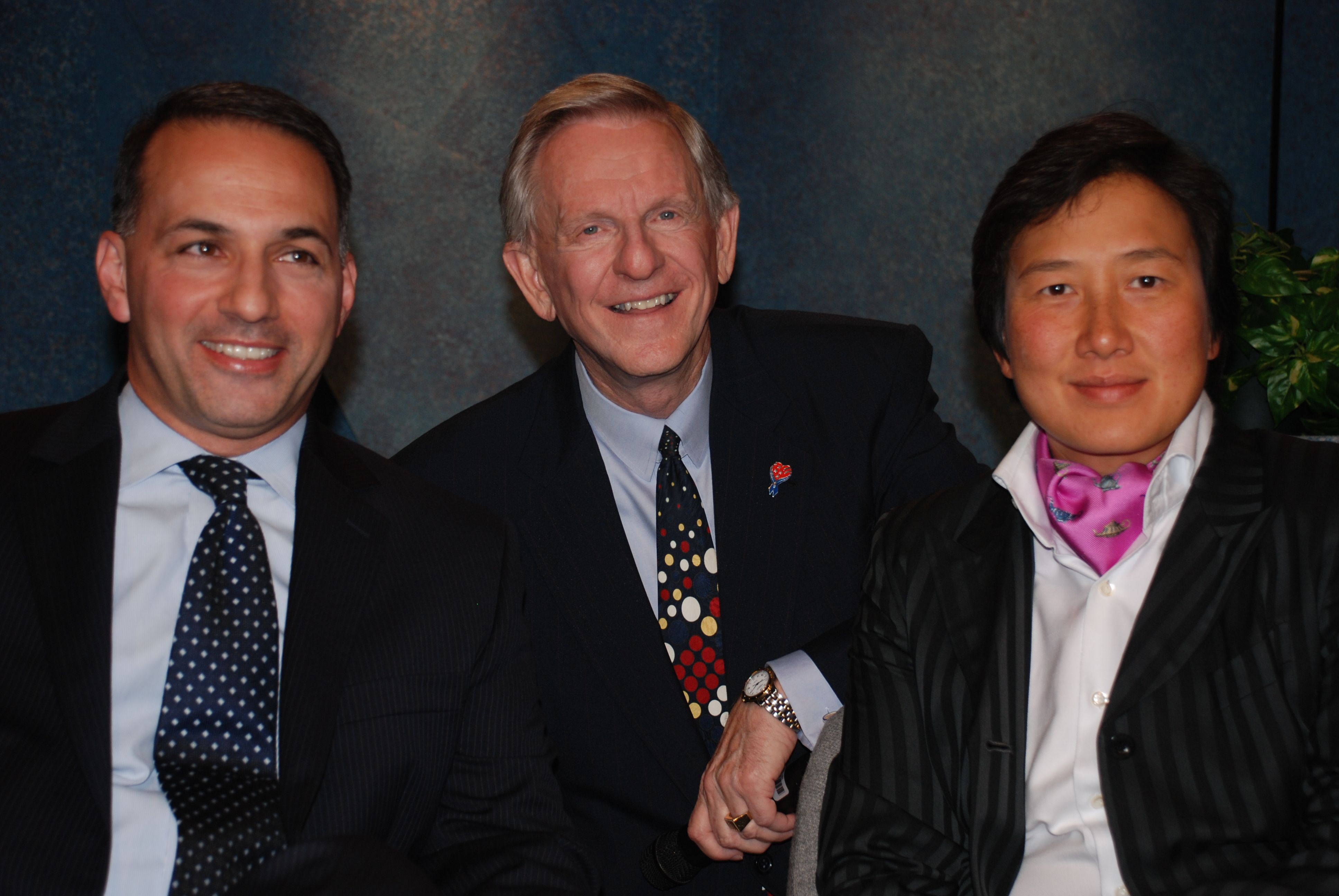
Dan Yergin, with Niki and Dennis

Dan Yergin, author of The Prize and The Quest joins McCuistion via a previously conducted interview. He states that with the increased availability of shale, gas and other technology driven solutions  America is on the verge of becoming more energy secure and  fast becoming more energy independent. In the near future America may be far less dependent on the Middle East for its oil supplies. We’re also twice as energy efficient as we’ve ever been.

Yergin maintains that net petroleum imports into America have declined from 60% in 2005 to 46% today. Further, the development of new ways of producing oil and gas through technology are huge factors in today’s energy security for America. The availability and price of energy affect our lives on a daily basis and with our close connection to Canada our pooled resources allow for imports actually going down. With US oil production up the good news is more money is being spent in the US rather than abroad, creating much needed jobs.

We also feature the late Matt Simmons; author of Twilight in the Desert, who talked about peak oil and the impact this could mean.

Joining us for the studio discussion,  bringing us the latest in energy news are:

  • Ed Blessing: Managing Partner, Blessing Petroleum, LLC;
  • Chuck Davidson, CEO of Noble Energy, Inc., and
  • Former Dallas mayor Laura Miller, now Director of Projects- Texas, with the Summit Power Group.

Laura Miller, once very much against dirty coal plants, is now working on a new concept involving building clean coal plants that capture 90% of carbon dioxide and sulphur; taking carbon dioxide, compressing it and pumping it back into oil wells. Summit has gotten significant grants – including $450,000,000 to work on these projects. Chuck Davidson’s company is far ranging, with exploration from oil and natural gas, in West Africa, Guinea, Israel, Mexico and Pennsylvania among others.  He informs us that the changes in technology have resulted in a 100-year plus supply of natural gas.

Ed Blessing believes that by 2017; if we continue on the present path of oil and gas exploration and safeguards, the US could well be the largest oil producer in the world. Production is increasing to a million barrels a day and this hemisphere could in fact be energy independent and energy secure. The good news is we have tremendous assets right here, positioning us for future security.

For the first time in a long time we should feel better about our long-term energy prospects.  While there are challenges, chief among them environmental concerns, we have renewable sources that are cost effective.

Energy security is critical to our future. We’ll be exploring these issues on two additional programs in the coming weeks so stay tuned, and go to our website at www.mccuistiontv.com, to view other programs on this and related topics.

Thank you for joining us. As always we appreciate your inviting us in to talk about things that matter with people who care.

Niki Nicastro McCuistion
Executive producer/ Producer
Business performance consultant
214-750-5157
nikin@nikimccuistion.com

***

02.26.2012 – 1920

Unless you’ve been asleep the last few months, you know about the “loosely” organized movement referred to as Occupy Wall Street. Its slogan, “We are the 99 percent,” has resonated with Americans from coast to coast. But mainstream media often sets out to get the most outlandish sound bite or portrays the more sensational rather than accurate story.  So, for most of us, the questions still remain:


Who are these people? What are their issues? What do they want? And what does it have to do with me?

Prior to taping a program on this topic, Dennis and I took cameras to the street to interview Occupy Dallas protestors. The protestors voiced their concerns with the American economic system and the impossibility of trying to live on minimum wage. They expressed their anger at the business world and how increasingly business is corrupt and has damaged the American dream.

The protestors were vocal in their frustration with “the top few having all the wealth”.  They expressed concern at how today more college graduates than ever before are jobless and shackled with overwhelming debt and increasingly overwhelmed with their downward spiral. Some expressed no hope.

Our studio panelists are experts on this topic and give succinct comments on the situation’s cause and current status.

Joining us are:

  • Cal Jillson, PhD – Professor of Political Science, Southern Methodist University and author of the newly released, Lone Star Tarnished: A Critical Look at Texas Politics and Public Policy
  • Jacob Hornberger – President of The Future of Freedom Foundation
  • Jonathan F. Winocour – Attorney
  • Glynn Wilcox – Advisor to Occupy Dallas

More than a history lesson, our panelists and man/woman on the street, present a vivid picture of the facts on the ground.

Jacob Hornberger believes we need to eliminate the welfare state and restore the principles on which this country was founded. Cal Jillson talks about the concentration of wealth and that this has been repeated in our history before- even back to Andrew Jackson who fought against the first banks. Jonathan Winocour says that this is not just an American historical phenomenon but a global movement. He states that it started with the Arab spring and that this present situation is more than a dispute between Hamilton and Jefferson. Glynn Wilcox, who has been up front and center with Occupy Dallas talks about the frustration of crony capitalism and what is continuing to destroy the American dream.

Left wing critics of the Tea Party say that many in that group didn’t have a good grasp of the issues or of politics and elected officials. They were often correct. Right wing critics of Occupy Wall Street say the same about them, and they too are often right. Yet, what may be true about both groups is that both intuitively know that there is something not quite right with where this country is headed.

On this episode covering the Occupy Wall Street movement, our panelists challenge us to ask tough questions, of government and of business.

Thanks for joining us as we talk about things that matter…

Niki Nicastro McCuistion
Executive Producer/ Producer
Business consultant /speaker on transformational change…
nikin@nikimccuistion.com


***

02.19.2012 – 1924

We keep trying to figure out just what caused the mortgage meltdown and credit crisis, and one might very well ask, “Didn’t anyone know what was  going on? Did anyone ask? Did anyone care?”

The  truth is – many did. Richard Bowen, now a  Senior Lecturer at the University of Texas- Dallas, the Jindal School of Management, was one who did. Richard was the Business, Chief underwriter at  Citi Financial, a subsidiary of Citigroup. His job was to oversee the credit quality of $90 billion of mortgage loans, which had been purchased by Citi from mortgage companies and banks. Some of these loans were sold to Freddy Mac and Fannie Mae – which are now in conservatorship with the Government.

Richard Bowen noticed that over 60% of these loans did not meet accredited guidelines. He attempted to warn everyone in his business unit that Citi  Financial had a serious problem with these mortgage loans. That problem eventually escalated from 60% to 89% of these loans not meeting quality standards — yet he was still ignored. Richard Bowen again warned all of  the key parties at Citi Financial.

After  attending a UT-Dallas, Institute for Corporate Governance seminar, and listening to  Michael Oxley, one of the key writers of Sarbanes- Oxley, he realized he had no ethical choice but to take action regarding  Citi Financial’s ignoring his warning signals. So he did. Yet, while investigations proceeded, little to nothing was done. His complaint was relegated to almost non-existence and given little to no attention.

Richard Bowen took further action. He  became a whistleblower. Today he is no longer with Citi Financial. In this episode we learn more about Bowen’s story and the role he played.

From Left to Right: Richard Bowen, Dennis McCuistion, and Wayne Shaw

We hear from Dr. Wayne Shaw, Helmut Sohmen Distinguished Professor of Corporate Governance; KPMG Institute for Corporate Governance at Southern Methodist University, about  the other side of whistleblowing and what an individual may encounter in the process. Dr. Shaw talks about what whistleblowing is, how it works, and the risks to the person who blows the whistle. According  to Wayne Shaw; people who take this step often lose their jobs and are shunned; often not getting a job in their industry again.

Ultimately, becoming a whistleblower is a choice- and one with, perhaps, heavy consequences. Yet, the ultimate question may be one of personal integrity. If something is wrong, do you keep quiet so as to protect yourself? Or stand up and take the risks?

Thanks for joining us:

Niki Nicastro McCuistion
Executive Producer/ Producer
Business consultant on transformational change…
nikin@nikimccuistion.com

***

02.12.2012 – 1923

This entry is part 3 of 3 in the series corporate governance.  

Corporate Governance - ChinaDuring McCuistion TV’s episode on Corporate Governance and its impact on China and the world, they address three questions related to the credit crisis and corporate governance:

- How do the Chinese see our economic situation?
- How has trade impacted what multinationals do?
- How has American economic and foreign policy impacted the rest of the world?

Guests include:

Angelina Kwan: Managing Director and COO, Asia Pacific, Cantor-Fitzgerald
The Hon. Mario Mancuso: Partner, Akin Gump Strauss Hauer & Feld, LLP, Former Under Secretary of Commerce

One of the points that host, Dennis McCuistion, addressed was that by-and-large we as a society do not often talk about China when discussing the American credit crisis and corporate governance, although it does impact them. He asked Angelina Kwan for her perspective.

Ms. Kwan believes that,

“The US is China’s best past and present trading partner. China wants a strong dollar. China really thinks that America has a great entrepreneurial spirit and it will get out of the current trade deficit.”

Ms. Kwan states that China will continue to work with the US and not in an adversarial role, but first and foremost as trading partners.

Dennis agrees, “We, the US and China, need each other. China is the largest creditor of the United States. We need to both figure out how they [China] will get paid.”  Angelina Kwan tells us that the US needs to look at how it’s dealing with their dollars and its fiscal policy. China and the US are having serious discussions about China exporting less and the US having less dependency on exports and not relying so heavily on Asia and China.

The guests agree that trade is good for both partners. Mario Mancuso adds,

“A prosperous China is in the best interests of the United Sates and vice versa. Both being prosperous is in the global interest. These are the two largest economies in the world, and we agree on our ultimate objectives. We just can’t figure out how to implement those objectives- that’s the irony.”

He tells us, 95% of our customers are outside the US and if we build a wall, we close competitors out.

“A rules-based trading system is advantageous to competitive parties and the US is the most competitive in the world.”

US consumers benefit with better products at cheaper prices…

“An additional point, I take a backseat to no-one in terms of levying criticism, at the same time I don’t think the final chapter has been written on US economic leadership.”

UTDAnd a special thank you to the Institute for Excellence in Corporate Governance,University of Texas at Dallas, School of Management, (http://som.utdallas.edu/iecg/) for providing the guests for this 4 part series on Corporate Governance.


Tune in for the rest of the story as continue to talk about things that matter with people who care…

Niki Nicastro McCuistion
Executive Producer/Producer

***

1809 – 11.22.09